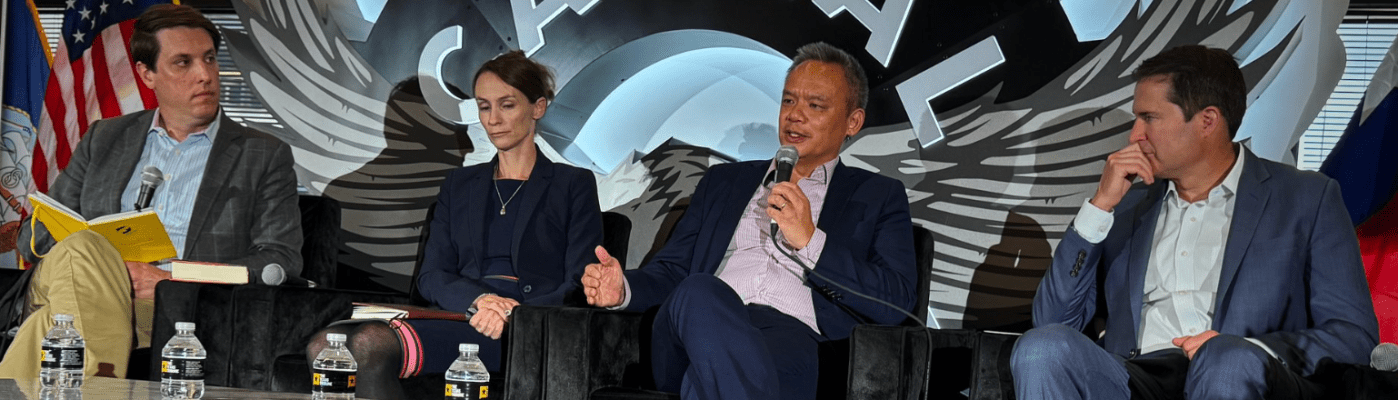

Panelist discuss U.S., China, and Taiwan
There is consensus among policy makers and analysts that the threat of China to the U.S. is the number one concern: not Ukraine; not Gaza. The U.S. Department of Defense and the U.S. State Department share this belief and this has become a bipartisan concern (not Dem vs GOP).
Containment of Russia has been a long-term policy, but the U.S. attitude towards China is not like the old “cold war” with Russia.
The Communist party believes that external disorder leads to internal disruption and Chinese citizens cannot be separated from the values of stability and order espoused by the Communist party by removing the party leaders and the party propaganda. Chinese attitudes about what makes a good citizen about definitions of patriotism, about nationalism, and about expansionism are very different from American citizens.

Past and Current U.S – China policies
Obama was supportive of the rise of China. But a change has come. There is now:
- Increased repression in China
- Increased aggression abroad by the Chinese government
- National Chinese security policies are expanding
- Xi has a different national strategy for China’s future
- The greater the power of China, the greater the risks to other nations
Facts about China versus propaganda:
- Industrial connections with China are dwindling and industry growth is trending down
- China claims it’s GDP is 5%; the U.S. believes that China’s GDP is more like 0%.
- The Zero Covid lockdown was part of China’s economic downturn but it has continued to be stagnant.

Strategic plans
The U.S. must plan a 20–30-year, long-term goal of what we want to achieve Liberal economic policies brought about by business relations between China and capitalist nations have created political risk for the Communist Party, with a expansion of far-flung power centers that could challenge Communist Party control.
Taiwan is of great economic importance to the U.S. The population of Kiev was in general denial that Russia would attack the Ukraine. There is currently a similar attitude of denial that China will attack Taiwan. Dictators often say exactly what they plan to do. Xi has stated that China will attack Taiwan and that they are preparing an amphibious attack. Chinese technology, in an act of war, could take out our satellite systems to make it difficult to respond to Chinese aggression on Taiwan.
Three strategic options for the U.S. and Taiwan:
- Choose to not help Taiwan defend itself, but the U.S. is very much dependent on Taiwan semiconductors. Being cut off from trade with Taiwan could cause a depression on par with the Great Depression. But Taiwan cannot defend itself against China aggression.
- The U.S. could get into the fight. We could “win” but it must be done with a multitude of conventional weapons. A lack of conventional weapons could drive the idea of using nuclear weapons. Casualties are estimated at 50-100K if we engage in a war with China.
- Deterrence is the best of the three options. But note: deterrence failed for Ukraine (sanctions, etc.). How could the U.S. deter China from attacking Taiwan?
Deterrence acronym: DIME
- Diplomatic
- Informational
- Military
- Economic

Competitive global alliances
Meanwhile, other Indonesian countries are developing alliances with China and even Australia has been bullied by China. It is a matter of logistics: China provides local security back-up in smaller countries with swift response. The U.S. must compete more effectively to offer support to various small countries and island territories.
More information
For historical perspective, the 1995 book by Richard Madsen “China and the American Dream: A Moral Inquiry”
Info on Sheena Chestnut Greitens, Director, Asia Policy Program, UT Austin. https://asiapolicy.utexas.edu/team/sheena-chestnut-greitens/
The UT Asia Policy Program https://asiapolicy.utexas.edu/
 Newosity: future report