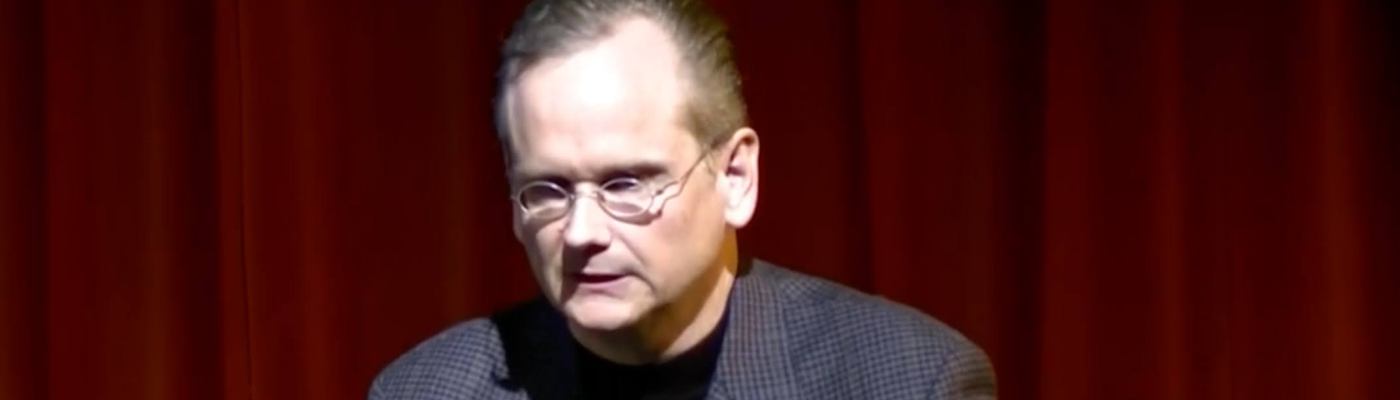

Larry Lessig, professor of law at the Harvard School of Law and Director of the Edmond J. Safra Center for Ethics, co-founder of Creative Commons, and (briefly), a 2016 Democratic presidential candidate. Lessig was interviewed by Karen Tumulty, a correspondent for The Washington Post.
For context (from Wiki): Larry Lessig described his candidacy as a referendum on campaign finance reform and electoral reform legislation. Lessig dropped out of the Democratic primary on November 2, 2015, shortly after the rules for participation in the next debate were changed such that he would no longer qualify.
Why?
Tumulty: Long an Internet Hero, this professor of law at the Harvard School of Law and director of the Edmond J. Safra Center for Ethics is not only super smart but he’s also supercharged with the kind of ethics we wish our leaders had. He announced his candidacy in September. Since every grassroots group has a hero in the race, now we tech and Internet geeks have a candidate on our side. Not like Gore… I mean he did invent the Internet, after all. But this guy is doing battle against aggressive copyright and trade law restrictions that choke create content, and fighting radio frequency choke holds on the use of the broadcast spectrum. But… “Larry Lessig for President?”
Lessig: I’m as surprised as you are (probably). But I’m good with it.
Lessig’s friend, the late Aaron Swartz, said that citizens should give up their work and take up a cause to build a movement to address corruption in government and to defend representative democracy. Swartz developed many internet protocols. He was a research fellow at Harvard and was heavily involved in activist anti-corruption movements. Lessig is taking a principled stand.
Loose funding regulations fuel political corruption
Lessig is concerned about the influence of money in U.S. politics. In a Citizens United environment, 158 families have given 50% of the money that will be used to compete in the 2016 elections. That concentration of influence is unacceptable.
After Watergate, we set up presidential fundraisers. Reagan ran on funding from three fundraisers. By 1984, it was eight fundraisers. Obama attended 228 fundraisers while running for president.
“Congresspersons are spending 70% of their time dialing for dollars.” We are in the Wild West now that there is less transparency about campaign funding. Bernie Sanders has said that for the rich, this money is peanuts. If we don’t fight against this trend, representative democracy could disappear. Politicians could ignore everyone else and focus on the very small group of high funders.
Gerrymandering
The U.S. House is riven with political gerrymandering. Districts are not fairly configured. Politicians pick their voters instead of voters picking the candidates. 345 seats are not competitive; a minority candidate cannot win in those seats due to the way that areas are drawn.
Voting hurdles
Are you able to stand in line for a half hour, or all day, waiting to vote? Not if you are a working person with children who may be juggling two jobs. That’s a time “poll tax” that you may not be able to pay. It’s discrimination and voter suppression when we make it harder for some to participate in democracy than others.
Solution
Ending the unrestricted election contributions, drawing districts fairly, and making it easier for all citizens to vote as Lessig’s goals. Restoring citizen equality to even the playing field would be the cure for this corruption.
Complications for candidates
The rules that govern who can run require large sums of cash to pay for commercials to raise public awareness of the candidate and for extensive travel.
“It’s almost impossible if you are not a billionaire or a politician. If I was a senator, I would go around the nation campaigning and it would be paid for by the govt. but once I announce my candidacy for president, I can no longer collect my salary as a Harvard professor. I also cannot currently collect any of the public funds.”
How about bottom-up citizen funding? Or, why not give every voter a voucher and they can give them to the candidate they want to fund. Money coming from millions, not from a few hundred people. Or try a matching campaign, taking only small contributions. This reform could be enacted tomorrow. Instead of spending time on fundraisers and calling for money, money would be raised with small contributions.
We need to change the rules so that Congress can be free from the funders. We must take our democracy back.
 Newosity: future report