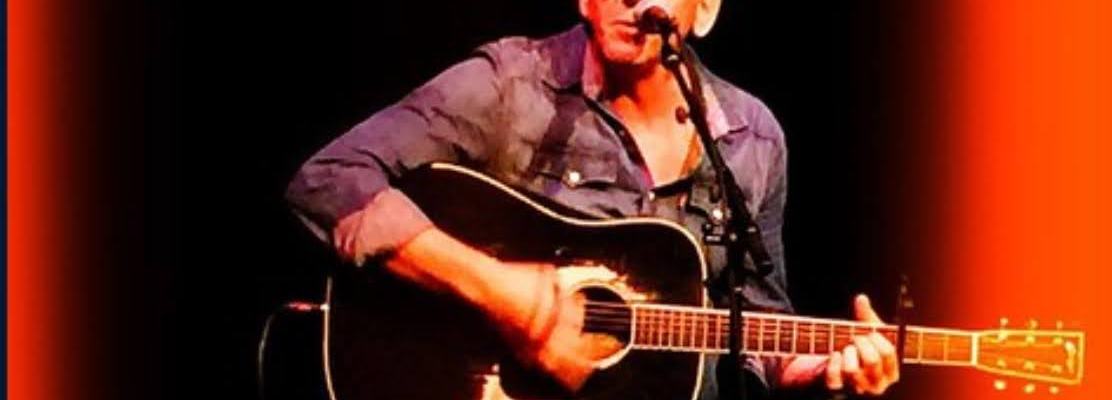

Darden Smith at the Austin Forum on Austin Music: Music and Tech — the Perfect Storm. (Texas State Theatre).
The perfect storm: high costs and low revenue
Darden Smith kicked off the Austin Forum playing some righteous tunes, strumming his beat-up guitar, embracing us in his Sweet Lovin’ Arms. Austin at its finest. Smith said Sweet Lovin’ Arms, released in 1993, paid the rent for three years. The song he’s singing for us now has been played three million times on YouTube, but its revenue is not so sustaining. The music business is a Chinese vase that has dropped and shattered into pieces. The pieces are still there, but how do you use those shards to distribute your music and make enough money to pay the rent? And if you live in Austin, Texas, the rising cost of living might not keep a roof over your head.
The panel, including Jennifer Houlihan, Mellie Price, Chad Swiatecki, and Colin Kendrick, discussed the irony that Austin, dubbed the music capital of Texas, has become a city too expensive for creatives, especially its hometown musicians.
Can the tech community assist musicians, who may tour frequently and need flexible work opportunities? Techies are thinking about setting up coding camps to teach musicians to code, so that they can add another skill besides making coffee and being prep cooks. (I’m not buying this idea and neither should you.)
Could tech help to engage creative stakeholders to, for example, deliver information from City Hall about what is planned for discussion at the City Council, so that stakeholders can create a flash mob to oppose noise ordinance codes? (Puw-leaz! What musicians need from tech is a way to get paid for their work.)
Even Canada gives Austin a failing grade
A Canada poll assigned “grades” to various cities about how their policies affected creatives. Austin’s report card was D’s and C’s, with one B grade for having a Music Advisory Board.
For one example of why Austin was graded so poorly: the city will not legally distinguish “busking” from “loitering”; therefore a street performer can be arrested midway through a performance of Free Bird (I am on board with charging public renditions of Free Bird as a high crime; pun intended.)
Ticket prices have increased very little for local bands. Higher ticket prices are only for touring bands. From bars to restaurants to coffee shops, a fair amount of money is made by business owners while the entertainment is often performed for free or for tips.
Mellie Price of Softmatch says that Austin has an angel investment community behind the tech startups. Price, who has started a number of ventures, wants to help artists get the amplification they need to get their music heard. E-commerce has gone from 1 percent (1999) to 7 percent of the US economy. Internet music sales is a fledgling business.
It’s natural to want to apply tech innovations to the Austin music community. In theory, this should lead to a more equitable distribution of the music revenue stream. But this is not happening.
That is because tech scrapes creative content (musicians, writers, image creators, etc.) and sells ads around it on an app or web streaming service. Content is not something that tech people believe anyone should have to pay for. Coding is the only creative skill that the tech industry thinks should be paid for. End of story.
Musicians, don’t expect a damn thing to happen around this issue. Just like writers, artists (including digital artists), will be ground up by technology until someone creates an app that requires micropayments to the musicians to listen to their music ad-free. Don’t hold your breath for that to happen.
Much talking about the book, “How Music Got Free”. Chad Swiatecki talks expansively and aspirationally about how this is going to be possible. See “How Austin can follow Nashvilles lead to amplify its music community” in the Austin Business Journal. (Seriously? Nashville?)
$1.6-1.8 billion dollar impact of the music industry (statistics from 2011) on the Austin economy. Probably more like 3 billion, just live music performances, SxSW, recordings of live performances, etc. ACL festivals..add all that up. Lots of money exchanging hands — almost none of it goes to musicians. A “staggering” idea in the town where almost no woman, ever, paid a cover to get into a live show, (Sorry, Liberty Lunch, Rauls, Emos, et al.) Content? We don’t pay for that!
We pay for liquor. We pay for touring band tickets. According to the speakers, some bars in Austin are literally staying open as a “public service.” (Beerland, Mohawk). Well, if you don’t count the sales of drugs and kickback, then okay, all of Red River is a charity op. Dance clubs, like… Barbarella. But lots of money made with canned music clubs.
Lots are doom talk about the death of the Austin music scene. Construction, high cost of living, low cover charges for local bands, local clubs closing. Bars are trying like mad to figure out how to survive, but they are surrounded by cranes and tech is in overdrive. the struggle is real. (Kleenex, anyone?)
So, why not a music incubator for a band and not just for the music tech business? Because…well, musicians are …creative and weird. (like tech guys aren’t?) but Nashville, Chicago, New York City, Los Angeles does it…why not Austin? Are we just stupid?
Example: long long lines for Fun Fun Fun festival for ticketing and scheduling. Lots of apps are being developed to help organize music event ticketing, payment, event information, and maps. Could there be a hackathon, after a city survey about what is needed? Send pizza. Marketers need a way ” to collect money without taking money at the door.” How about a way to tip from your phone to the band that’s playing and not a sad little tip jar? How about a tip jar app that is location aware that can send tips to a nearby musician who has an account with the app? How about giving something back to the tipper (like a free download from Garageband)?
On they go, winking tiddles into a tiddle cup (as Humbert Humbert put it).
Two guys who founded Black Fret: Colin Kendrick and Some Other Guy…is it .Chad? Please let it be Chad. Patrons of Local Music. Dedicated to helping local musicians in a nonprofit. They thought “Why not have a symphony or opera-style organization that supports musicians in the way that those associated with classical music have patronage?” Austin Music Foundation was a group of this nature, wasn’t it? (Run, run far far away.)
Help keep Austin, Austin. But these guys are not from Austin.
Everyone connects with music. It’s a communal experience to share the experience of hearing music as a group. Tech has always been a part of it, because musical instruments ARE technology, from the first bone that was struck on a drum. Deep water and I feel a chill.
The age of the record label dominated music, founded on the principle that it took a lot of money to distribute vinyl. This paradigm is no longer as valid as it once was. Yet somehow stll some dude is still in the middle, making a ton of money off musicians and the musicians mostly go hungry. Even the stars are often tied up in contracts that screw them for homework. It’s still a broken system and tech instead of fixing it, has done a dance around it, starting with Napster and continuing with Spotify and Pandora and Amazon Music, and…and, and.. Someone is still making money It’s still not..you, the musician.
CDs are still, incredibly, still dominating the current marketplace. (well, they were 10 years ago.) Even at 50 percent, downloaded singles comprise half of the pie, and downloaded albums comprise the other half. So, it’s Apple and Amazon and wherever else you download your music from (if indeed you are one of the ones still paying for it). CEO Colin Kendrick is connected somehow to McCombs at UT Austin. That is one more red flag, isn’t it? :-\
Looking at the chart displayed, there is nothing to show streaming music revenue. It’s not even on the chart. cue next chart.
Streaming is now 27 percent of the music business revenue. How much of that is going directly to the musicians? get real. Musicians make money from touring. Period.
So, just what is Black Fret’s mission and how can this help? Is this to bootstrap artists into the position to get their content into the same unfair revenue clip service? Looks like patrons get to attend events and rub up against musicians. Okay, fair enough. Most of them are tending bars in their free time, but hey why not? it’s cool. Nominate which bands get a grant. and other interactive “fun” for crowdsourcing our content creators. Is this the equivalent of a musician’s industrial affiliate program? Maybe take them all on a cruise or to Sandals.
$100 per month for members to attend private monthly events and vote for bands to get grants. 2 million each year, 1000 members at this time speed tie to market. or speed time to slaughter, your choice.
Another institution has come alive, welcome to Austin: the music capital of the ….oh, fuck this.
2023 Update
JFC, both these guys are still grifting. Chad Swiatecki is selling get rich schemes, offering writing tips for money, reposting investment scams. Black Fret changed its name to Sonic Guild and somehow they are giving money to musicians. The company has expanded into several cities where music is relevant to the local economy.
 Newosity: future report